
Iran attacked – global consequences
The military actions undertaken by the United States of America and Israel against Iran, commencing on 28 February 2026, which follow up their attacks on Iran’s nuclear program and air defence infrastructure over 13 – 24 June 2025, have irrevocably changed the political and military landscape of the Middle East.
This change will be felt globally across geopolitics and economics, and more.
The Iranian regime’s role since 1979 as an anti-America, anti-Israel, anti-Sunni, and anti-Western democracy sponsor of terror places it in a small clutch of nations whose interests are inimicable to Australia’s interests as a pluralist democratic state.
Geopolitics
Iran declared itself an enemy of Israel, and regional Sunni-led states, since the Shia theocracy seized political power in 1979. The theocracy’s stated international outlook has been, since 1979, “death to America, death to Israel”. Whilst since 1979 Iran has not officially viewed all Sunnis as enemies, rather focusing its rhetoric on “unity” against Western and Israeli influence to collaborate with Sunni entities including Hamas, in practice the Shia-led state often treated international Sunni political movements as adversaries.
The Iranian regime has, since 1979, sponsored terrorism in the Middle East and globally, including at least two publicly attributed acts in Australia in 2025 against Jewish targets in the wake of Hamas’ 7 October 2023 attack on Israel. This public revelation by Australia’s prime minister resulted in the Australian Government ejecting the Iranian ambassador.
The Iranian theocracy has harboured a long-term program to develop a nuclear weapon capability, and the long-range missiles on which to mount them, in order to enable its “death to America, death to Israel” mantra. Many pundits have assessed over decades that Iran would use nuclear weapons against Israel, America, and others if given the chance. America has led decades of global political, diplomatic, military, and intelligence-based physical interdiction to deny the Iranians a nuclear weapons capability.
The people of Iran will be the most severely affected by the war, with no certainty about the future of their governance, security, economy, and personal wellbeing.
People in the Middle East, including over 100,000 Australian citizens in the region, are suffering from Iranian retaliatory missile and drone strikes and the resultant personal safety, transport, and economic dislocation these attacks cause.
Economics
Iran produces over three million barrels of oil per day, about four percent of global output. Of these three million barrels, about 80 percent is sold to China.
More importantly, Iran can control the Strait of Hormuz through which other Gulf countries ship oil, about 20 percent of daily global supply. About 45 percent of that Gulf oil is bound for China, the global manufacturing powerhouse. Further, about 40 percent of global LPG supplies pass through the Strait. Oil tankers, LPG tankers, and other ships in the Strait are subject to GPS jamming and Iranian drone strikes.
Slowing the passage of oil and LPG, by endangering the tankers that pass through the Strait, will have the effect of driving up oil and LPG prices globally which will directly impact hydrocarbon energy pricing for consumers and producers, causing a spike in inflation, supply chain disruption, insurance, global economic uncertainty, and possibly long-term fuel shortages.
For critical infrastructure operators, geopolitical crises rarely remain distant events. Energy markets, cyber operations, foreign interference, and ideological polarisation can quickly affect workforce stability, supply chains, and operational resilience.
Looking beyond the global – what about Australia?
Australia will suffer from the broad geopolitical and economic consequences of the attack on Iran. In Australia, the most obvious consequence will be even more pressure on Australians and the businesses they rely on. Australians are already suffering searingly high daily cost-of-living. The war will inflict, at least for months, broader inflationary effects that will result in increasing input costs which will chill economic activity and decrease Australians’ disposable income. Given the spending habits of many Australian governments, this war is likely to increase Australia’s record public debt.
According to the Department of Home Affairs, as of early 2026 the Iranian-born population in Australia is estimated to exceed 95,000 people (and presumably the size of the Iranian community will be higher because of their children being born in Australia). This community has experienced significant growth over the past decade, with a 63.5% increase in Iranian-born residents in Australia between 2013 and 2023.
With respect to the expatriate Iranian community, Pentagram wrote in 2025 about the threat of foreign interference, sabotage, and espionage to Australia and its people from Iranian government and intelligence agencies. Expatriate Iranians are especially vulnerable to these threats.
The removal of the Iranian ambassador in 2025 did not mean the closure of Iran’s diplomatic mission in Australia. The embassy remains a safe base for Iranian state-sponsored intelligence collection and acts of aggression. In July 2025 there were media reports that exiled Iranians in Australia are being stalked and threatened with death by Islamic Republic agents. Such actions by foreign government officials constitute foreign interference.
In Australia, foreign interference is defined as activities carried out by, or on behalf of, a foreign actor that are coercive, clandestine, deceptive, or corrupting, and are contrary to Australia’s sovereignty, values, and national interests. This can include actions aimed at influencing political processes, stealing intellectual property, or undermining democratic institutions. It has distinguished from legitimate foreign influence, like diplomatic efforts, by its secretive and harmful nature.
Here is a more detailed breakdown:
- Coercive, clandestine, deceptive, or corrupting:
These are key characteristics of foreign interference. It is not just about open communication or diplomatic engagement; it involves hidden, manipulative, or forceful actions.
- Contrary to Australia’s sovereignty, values, and national interests:
This means the activities are harmful to Australia’s self-governance, its core beliefs and principles, and its overall well-being.
- Examples of foreign interference:
This can include:
- Influence on political processes: Attempting to sway elections, lobbying for specific policies, or undermining democratic institutions.
- Intellectual property theft: Stealing research, trade secrets, or other valuable information.
- Covert influence on research and education: Attempting to control academic curricula or research directions.
- Harassment and intimidation of individuals: Targeting individuals or communities to silence dissent or promote specific agendas.
- Distinction from foreign influence:
Foreign influence, when conducted openly and transparently, is a normal part of international relations. Foreign interference, however, is characterised by its secrecy and harmful intent.
- Examples of hostile foreign interference:
- Espionage: Spying on Australian individuals or organisations.
- Sabotage: Deliberately damaging infrastructure or systems.
- Cyberattacks: Hacking into government or private networks.
- Disinformation campaigns: Spreading false or misleading information to manipulate public opinion.
Social cohesion
Since Hamas’ 7 October 2023 attack on Israel, social cohesion in Australia has deteriorated to be the worst in living memory, perhaps the worst it has ever been since federation in 1901.
The fulcrum of this deterioration is a combined antisemitism and antizionism. Protestors, politicians, and commentators holding a pro-Palestine anti-Israel viewpoint have acted in Australia since 2023 to cause havoc. Some have undertaken violent acts in Australia against Jewish targets. Iran contributed to this mayhem, at least twice that the Australian public knows about, in directing attacks against Jewish targets in Australia.
Khamenei’s death, and the decapitation of the Iranian theocracy’s and military’s leadership, is linked to the 7 October 2023 attack.
Whilst Khamenei was Supreme Leader of Iran, he was also the political and religious leader for a large segment of the global Shia community, particularly in Iran, Lebanon, and within Iranian state-affiliated institutions. This broad constituency is represented in Australia through expatriate communities and their Australian-born children.
The Australian community harbours people who are ideological supporters of the Iranian theocracy, for whom the assassination of Grand Ayatollah Khamenei would be a tragedy. The consequence could be encouragement to them to amplify pro-regime activities they were undertaking in Australia because of Khamenei’s death.
Given Khamenei’s status in the Shia world, many non-Iranians will likely grieve his death on the basis of his religious affiliation and status. And they would blame America and Israel, noting Australia’s relationship with both. The motivation is there for some in our community to lash out.
People’s behaviour in the workplace: critical infrastructure and beyond
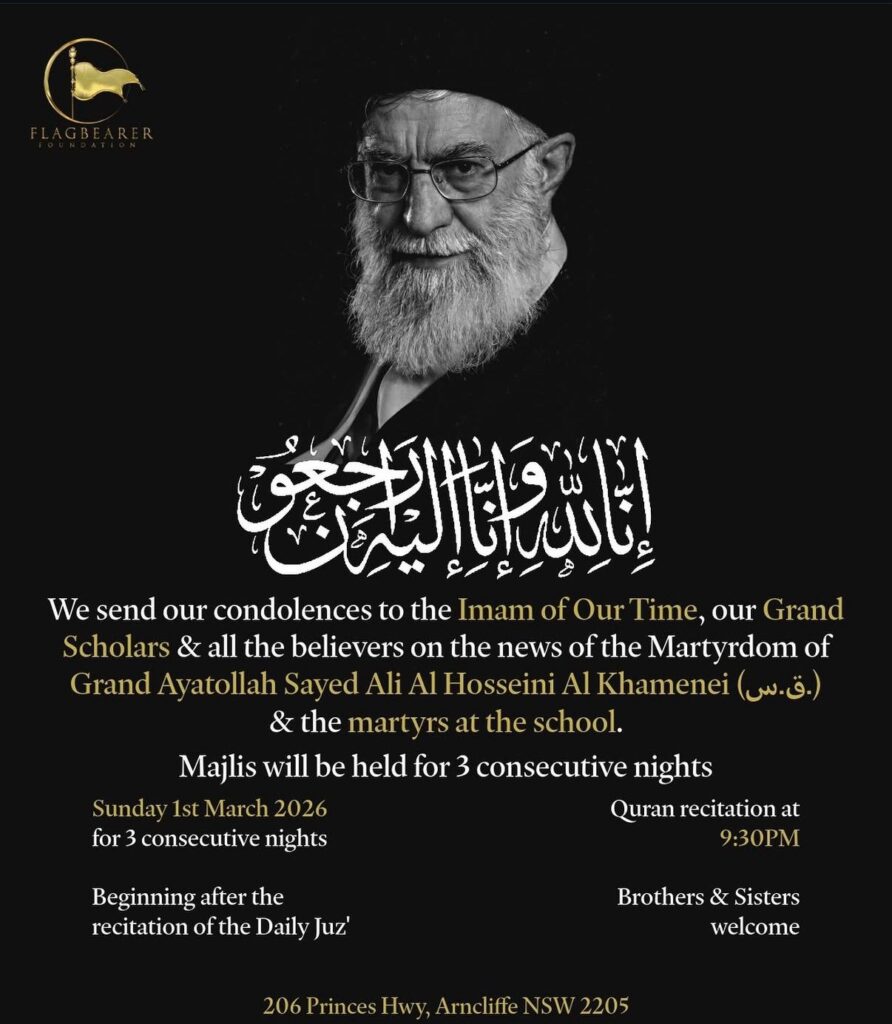
As the image heading this article shows, there are people in Australia who are mourning the death of Grand Ayatollah Khamenei and his theocratic confederates.
Some people in Australia have attended memorial services for Khamenei.
Given Khamenei’s status as a Shia spiritual leader it is understandable that devout Shia may mourn the death of their spiritual leader. However, given Khamenei’s duality as religious leader and leader of a state that sponsored global religious-based terrorism, there will be many in the Iranian expatriate community who may not mourn his death. Moreover, there will be many non-Shia people in Australia who may be confused and concerned about people in Australia mourning Khamenei due to his terrorist links.
Such polarisation of views, stoked by any ongoing military action against Iran which some Muslim groups and issue-motivated groups will portray to the broader Australian community as yet ‘another’ Western persecution and killing of Muslims in the vein of the wars against Iraq and Afghanistan, is likely to inflame passions and lead to aberrant behaviour.
This risk of impassioned behaviour can spill over into the workplaces of Australia’s critical infrastructure entities.
If there are expatriate Iranians in the workplace then employers need to be mindful that they may be at heightened risk of coercion by Iranian state-linked agents still operating in Australia or from overseas. It would be appropriate to discreetly ‘check-in’ with these colleagues to ask about their wellbeing in the wake of the American-Israeli attack on Iran and the assassination of Khamenei.
Further, and especially for critical infrastructure entities, now is a time of heightened risk of sabotage and espionage from people either loyal to the Khamenei regime or mercenaries being paid by the (former) regime to act against your critical assets and operations as a retribution for recent events. Beyond those in direct thrall of the former regime, there are issue motivated groups in Australia that are strongly opposed to the State of Israel and to America.
They are pro-Muslim anti-Western, including pro-Shia (via the proxy of anti-Israel Sunni Hamas). People in the issue motivate groups that fall under this banner may also pose a risk in the workplace, either directly through their workplace behaviour or by coercing or bullying others in the workplace with whom they disagree.
There is no certainty that the theocracy will be removed because Khamenei and his high command have been killed. A variation of the regime could take political power in Iran and it will be looking for retribution against any target. We, in Australia, would be seen as ‘soft’ targets.
Empirical facts versus ‘my’ facts
The empirical facts are that the Iranian Shia theocracy has threatened and killed American and Israeli citizens (and others) since 1979. That Iran has pursued missile and nuclear weapons programs. That the theocracy’s intent is to erase the State of Israel and strike the American homeland. That the theocracy has sponsored terrorism globally for decades causing the deaths of thousands of non-combatants.
For a Shia Muslim, these empirical facts may have no resonance. They might prefer their own personal ‘my’ facts which will likely be dismissive of the empirical facts. They will take a personal view shaped by their life experience and religion. Australia’s workplaces will have some ‘my’ fact people. They are of course entitled to their ‘my’ facts, unless they choose to act on them in the workplace, thereby threatening the secure operation of critical assets and operations, and the people who work them.
Is your organisation’s Security of Critical Infrastructure (SOCI) Act enterprise risk management framework designed and ready to identify any such aberrant workplace behaviour? Does it have an insider threat program in place to detect and respond to aberrant behaviour? If not, it is not meeting its SOCI obligations. It is not protecting its critical assets and operations, especially its people.
Implications for Critical Infrastructure Security
For Australian critical infrastructure entities, geopolitical crises can translate rapidly into operational risk. These risks may include foreign interference, cyber operations, insider threats, economic disruption, and social tensions within the workforce. Organisations responsible for critical assets should ensure their SOCI Act obligations, including personnel hazard management, insider threat programs, and supply chain security, are mature, documented, and actively monitored. Periods of international crisis often reveal weaknesses in organisational resilience and governance frameworks.
Pentagram has previously highlighted that insider threat and foreign interference risks are most effectively mitigated through structured governance, workforce screening, and behavioural monitoring programs aligned with the SOCI Act legislative framework.