
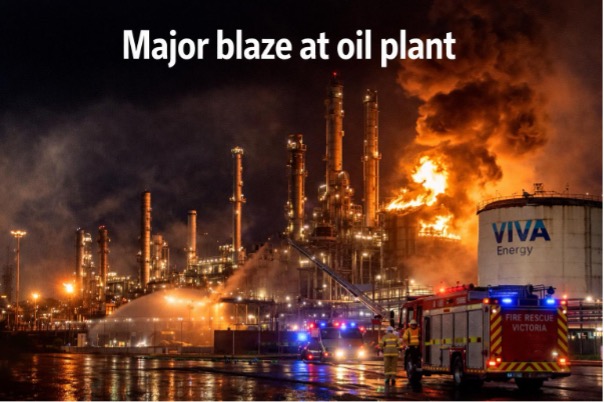
The fire at Viva Energy’s Geelong refinery should be treated as more than an industrial incident.
Initial media reporting points to equipment failure stemming from inadequate maintenance. There is, as of 17 April 2026, no public evidence of sabotage.
But focusing on cause alone risks missing the broader point.
For operators of critical infrastructure — and for government — the more important question is not what triggered this event, but what it reveals about Australia’s exposure when disruption occurs at assets that are, by any measure, nationally critical.
Because the Geelong refinery is not just another industrial site.
It is one of only two remaining refineries in Australia, supplying a significant proportion of Victoria’s fuel and a meaningful share of national demand. Its output underpins not only transport fuels such as petrol and diesel, but also aviation fuel, petrochemicals and inputs into manufacturing and packaging supply chains. Disruption at this facility has immediate and cascading effects across the economy.
The Geelong Corio refinery is designated in the Security of Critical Infrastructure (Definitions) Rules 2021 as a critical liquid fuel asset, bringing it within the scope of the Security of Critical Infrastructure Act 2018 (SOCI Act)and associated obligations.
The purpose of that framework is not compliance for its own sake. It is to ensure that operators — and the Commonwealth — understand where true vulnerability lies.
Australia’s structural exposure
Australia’s exposure in this domain is not incidental. It is structural. And foreseeable.
In 1979, Australia was almost self-sufficient in oil refining and production of petroleum products, with up to 10 oil refineries operating. In 2026, Australia has two oil refineries operating, yielding about 20 percent of domestic needs with over 90 percent of required product imported. These last two refineries are surviving on Commonwealth subsidies until 2027 to ensure some local production capacity.
With domestic refining capacity declining to two operating refineries, supplying only a portion of national demand, for the balance of its liquid fuel needs Australia is reliant on imports through extended and, at times, fragile supply chains. Fuel reserves remain substantially below internationally recommended benchmarks – a situation that has existed under a succession of commonwealth governments. The liquid fuel supply system is increasingly dependent on a small number of critical nodes.
In that context, disruption at a single facility is not simply an operational issue — it is a national security and resilience issue.
The absence of evidence of sabotage should not be confused with the absence of vulnerability.
That exposure is no longer theoretical. Australia is already experiencing the effects of global energy disruption driven by the conflict involving Iran, with fuel prices rising sharply and supply chains under strain. Recent analysis indicates that Australia holds only weeks of fuel reserves and remains heavily dependent on imported refined fuel, leaving it vulnerable to prolonged disruption if global supply constraints intensify. Fuel theft is occurring. Airlines are cutting flights and increasing airfares. Fuel rationing is very near.
In that context, disruption at a single domestic refinery is not an isolated operational issue — it compounds an already stressed system.
Before open conflict: the Ukraine pattern
In the years leading up to Russia’s full-scale invasion of Ukraine in 2022, a series of incidents occurred that, at the time, were often treated as isolated events.
Across Ukraine, ammunition depots experienced repeated fires and explosions between 2014 and 2019. In locations such as Balakliia and Kalynivka, large-scale destruction of stockpiles forced evacuations and disrupted military logistics. Initial explanations frequently pointed to ageing infrastructure, poor safety practices or accidental ignition.
Only over time did a different picture emerge.
Ukrainian authorities increasingly attributed these incidents to sabotage. Subsequent investigations pointed to hostile actors using methods designed to remain ambiguous — allowing incidents to be plausibly explained as accidents while still achieving operational impact. This ambiguity is not incidental — it is deliberate, complicating attribution and delaying response while still delivering strategic effect. It is activity that fits the definition of asymmetric warfare.
The effect was not a single decisive blow. The pattern was one of sustained pressure on capability through repeated disruption.
Stockpiles were degraded. Supply chains were disrupted. Operational readiness was eroded.
Notably, these incidents targeted logistics and supply chain nodes — depots, storage and distribution — rather than frontline assets, reflecting a focus on sustaining pressure on capability rather than achieving a single decisive strike.
Each incident, taken in isolation, could be explained away. Taken together, they formed a pattern of sustained pressure on critical capability.
That pattern was not confined to Ukraine. In Europe, explosions at ammunition depots in the Czech Republic and Bulgaria were later linked by authorities to efforts to disrupt defence supply chains connected to Ukraine.
The same pattern extended beyond physical infrastructure. In 2015 and 2016, cyber attacks on Ukraine’s power griddisrupted electricity supply to large numbers of customers, marking the first known instances of coordinated cyber operations against energy infrastructure. In 2017, the NotPetya cyber attack, attributed to the Russian military, was initially targeted at Ukraine but rapidly spread globally, causing widespread disruption to logistics, shipping and industrial operations.
The defining feature of modern hybrid warfare is not a single catastrophic attack, but the gradual accumulation of disruptions — each explainable in isolation, but strategically significant in aggregate.
These ‘incidents’ or attacks can be delivered through various means, but are frequently attributed to human activity. Such attacks can be described as sabotage which is defined as an act to deliberately destroy, damage, or obstruct (something), especially for political or military advantage.
The risk is consequence, not cause
Against that backdrop, the Geelong refinery fire should not be viewed narrowly through the lens of causation.
Whether caused by equipment failure, human error or — in a different scenario — sabotage or deliberate interference, the consequence is the same: disruption to a critical node in Australia’s fuel supply chain.
In critical infrastructure, consequence matters more than cause.
As recent history demonstrates, disruption does not need to be decisive to be effective — repeated, ambiguous and strategically targeted incidents can, over time, degrade capability in ways that are only fully understood in retrospect.
This is particularly true in sectors characterised by concentration risk, global supply dependencies and limited redundancy — all features of Australia’s liquid fuel system.
The SOCI Act and associated Rules require entities to identify and manage hazards across cyber, personnel, supply chain and physical domains, including risks arising from malicious actors and over-reliance on key suppliers.
But the effectiveness of that framework depends not on its existence, but on how it is applied.
From compliance to assurance
For many organisations, the SOCI Act Critical Infrastructure Risk Management Program (CIRMP) has been approached as a compliance exercise — a document to be developed and maintained.
That mindset is no longer sufficient.
In an increasingly contested geopolitical environment, critical infrastructure operators must move from compliance to assurance.
That means asking harder questions:
- Do we understand our true points of failure?
- Do we understand our threat environment?
- What controls are in place to mitigate threats to our vulnerable points?
- What happens if a critical asset is unavailable for an extended period?
- How dependent are we on single suppliers, systems or individuals?
- Are our controls designed for today’s risk environment, or yesterday’s?
As we have argued previously in the context of global energy disruption, geopolitical shocks cascade — through supply chains, into workforce stress, operational risk and organisational behaviour.
The Ukrainian experience demonstrates clearly how disruption can begin as isolated incidents and evolve into a pattern of systemic degradation.
Australia should not wait for that pattern to become visible in hindsight.
What this means for boards and executives
For boards and senior executives, the implications are immediate.
First, identify and test single points of failure — not only within assets, but across dependencies including suppliers, logistics and workforce.
Second, stress-test supply chain resilience, particularly where reliance on single suppliers or overseas inputs creates exposure.
Third, reassess personnel and insider risk, recognising that geopolitical and economic pressures can influence behaviour within the workforce.
Fourth, ensure that CIRMPs are not static documents, but are actively tested, reviewed and embedded within operational decision-making.
Fifth, undertake a threat assessment to determine the likely threats relevant to your asset and determine how vulnerable your single points of failure are to those threats.
A warning, regardless of cause
There is no evidence at the moment to suggest that the Geelong refinery fire was anything other than an industrial incident.
But that does not diminish its significance.
On the contrary, it highlights the reality that disruption to critical infrastructure — regardless of cause — can have immediate and far-reaching consequences.
In an increasingly contested strategic environment, those same points of vulnerability may become targets, whether directly or indirectly.
The lesson is not to speculate about intent. It is to recognise exposure — and to recognise patterns before they become obvious.
Because history shows that what appears isolated in real time is often understood, in retrospect, as part of a sustained pattern of disruption.
The next incident, whatever its cause, may not be so easily dismissed.