
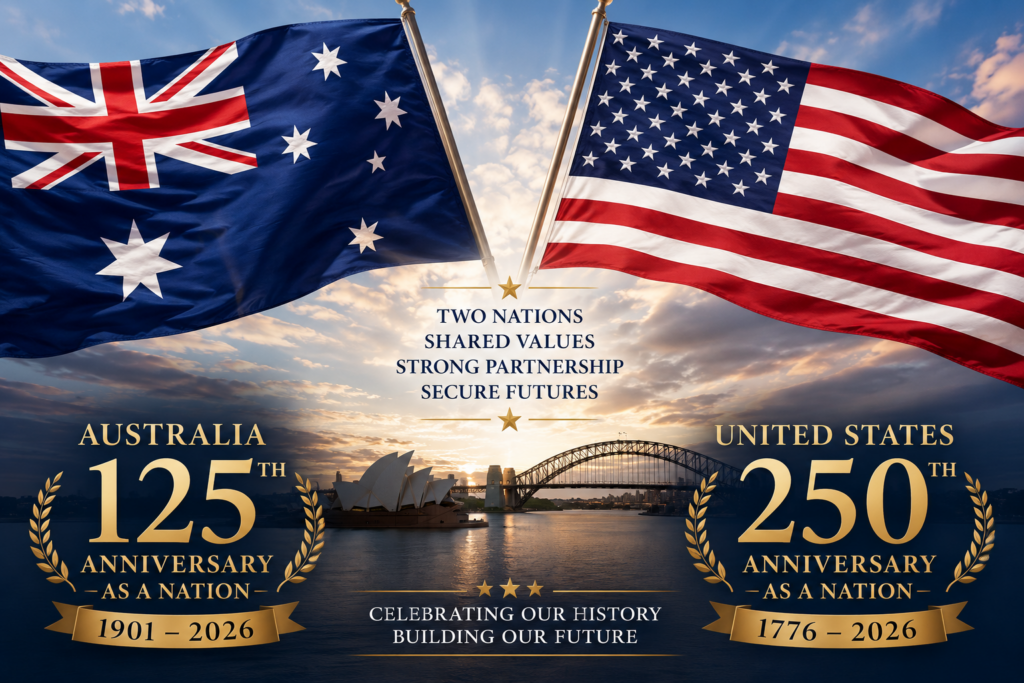
In 2026 there is a coincidence of two kindred anniversaries that are important for Australia. 2026 marks the quasquicentennial (125 years) of the founding of the Commonwealth of Australia and the semiquincentennial (250 years) of the founding of the United States of America.
Perhaps this is nothing more than a minor historical curiosity, but it gave me pause for thought as we approach 4 July – America’s birthday. Why? Because America is and will continue to be a fundamental influence upon Australia.
Australia is connected to the United States through our British and pan-European heritage. The Americans ultimately rebelled against the British crown and defeated the British army to become a self-governing republic, the first of its kind. The crucible of violent revolution against the British was not necessary for the birth of the Commonwealth of Australia, but we must recognise that America’s Declaration of Independence in 1776 was a contributor to Australia’s formation as a nation state.
Australia has looked to, and collaborated with, the United States for a long time.
America’s Great White Fleet visited Australia in 1908 at the request of Prime Minister Alfred Deakin because he wanted American support in the Pacific.
During World War I, at the Battle of Hamel on 4 July 1918 some 1,000 inexperienced U.S. troops from the 33rd Division were placed under Australian commander Lieutenant General John Monash to gain combat experience, with great success.
In December 1941, Australian Prime Minister John Curtin, declared that Australia “looks to America, free of any pangs as to our traditional links or kinship with the United Kingdom.” This marked a shift in Australia’s primary defence reliance from Britain to the United States.
Australia has fought wars alongside the United States in Korea, Vietnam and the Middle East. We have the ANZUS Treaty and AUKUS. But the relationship is not limited to war and military affairs. The United States has dominated, or heavily influenced, Australia’s culture, diplomacy, investment, economy, technology, human and medical sciences, music, literature, dress and more.
America is a unique colossus of a nation. And Australia has been wed to it, for better or for worse, and that union will continue in shape-shifting forms.
But Australia and America are not closely related. We are cousins, not siblings. America is the older and more experienced of the two and, therefore, through experience, has a great deal it can teach Australia about citizenship.
The United States was first an idea, an idea that had to be articulated, agreed, debated, fought for, designed, built, and operated. At its 250th birthday there is a great deal of criticism that can justly be levelled at the United States. There is also a great deal of praise that can be granted to America. It is, after all, an experiment in democracy. The first of its kind. The ‘idea’ of America of course is central to being a citizen of America. And it is this enduring concept of being a citizen first, to instinctively act for the common good, that is both powerful and elusive.
As Australia and America both mark these milestone birthdays, we find that both countries face similar challenges. Both are in the grip of societal fracture, of dangerous political and social partisanship, of attack by hostile states and hurt by criminality. And it is our governments, both styled in the form of representative democracies where the elected are charged by the electors to ensure the security of the state and the prosperity of its citizens, that will be the means by which we address our current and foreseeable difficulties.
America’s first president, George Washington, rendered a farewell address when he left office in 1796. Key themes in Washington’s address focused on:
- National unity
- Citizenship requires active civic virtue
- Respect for the constitution and rule of law
- Avoidance of political extremism and faction
- Independence from foreign influence
- Religion and morality support citizenship
- Educated and informed public
So how would Washington’s ideal citizen be described? A citizen is a person who:
- Places nation above faction.
- Respects the Constitution and the rule of law.
- Acts with integrity and civic virtue.
- Is informed and engaged.
- Resists foreign influence.
- Supports national unity.
- Accepts responsibilities alongside rights.
- Contributes to the long-term strength and stability of the republic.
Many of Washington’s themes remain central to contemporary discussions about citizenship in democratic societies, including Australia:
- Balancing individual rights with civic responsibilities.
- Maintaining trust in democratic institutions.
- Building social cohesion across political and cultural differences.
- Protecting against foreign interference and disinformation.
- Encouraging informed participation in public life.
- Recognising that national resilience depends not only on government but also on the conduct of citizens.
These ideas align closely with modern concepts of democratic resilience and national security, where informed, engaged, and responsible citizens are viewed as an essential component of a nation’s ability to withstand geopolitical pressures and internal division.
As Australia and America celebrate significant milestones in 2026, the idea of citizenship, and cultivating strong citizens, has been an enduring common cause.
In 2026 both countries find their history, their founding ideas, are under threat and many of their citizens are not upholding their responsibilities, often because they are too consumed in prosecuting their rights (real or imagined). The threats to Australian and America come from within, through partisanship and unbridled progressives, and from hostile states and entities that want to weaken our nations for their benefit.
The next time this symmetry between the foundation of Australia as a democratic federal independent nation being half the age of the foundation of the United States of America will be in the year 2276. What will Australia and America be like then? Let’s hope better than today.
Our citizens need to act to uphold the idea of these democracies. Citizens need to counter those detractors that see only the bad (and seek to gain advantage for their group in doing so) and are blind to the good. Citizens need to build, not wreck.
In terms of birthday wishes, mine is that both Australia and America can soon truly rekindle the ideas they were built upon by encouraging citizens to take up their responsibilities to put their countries first.